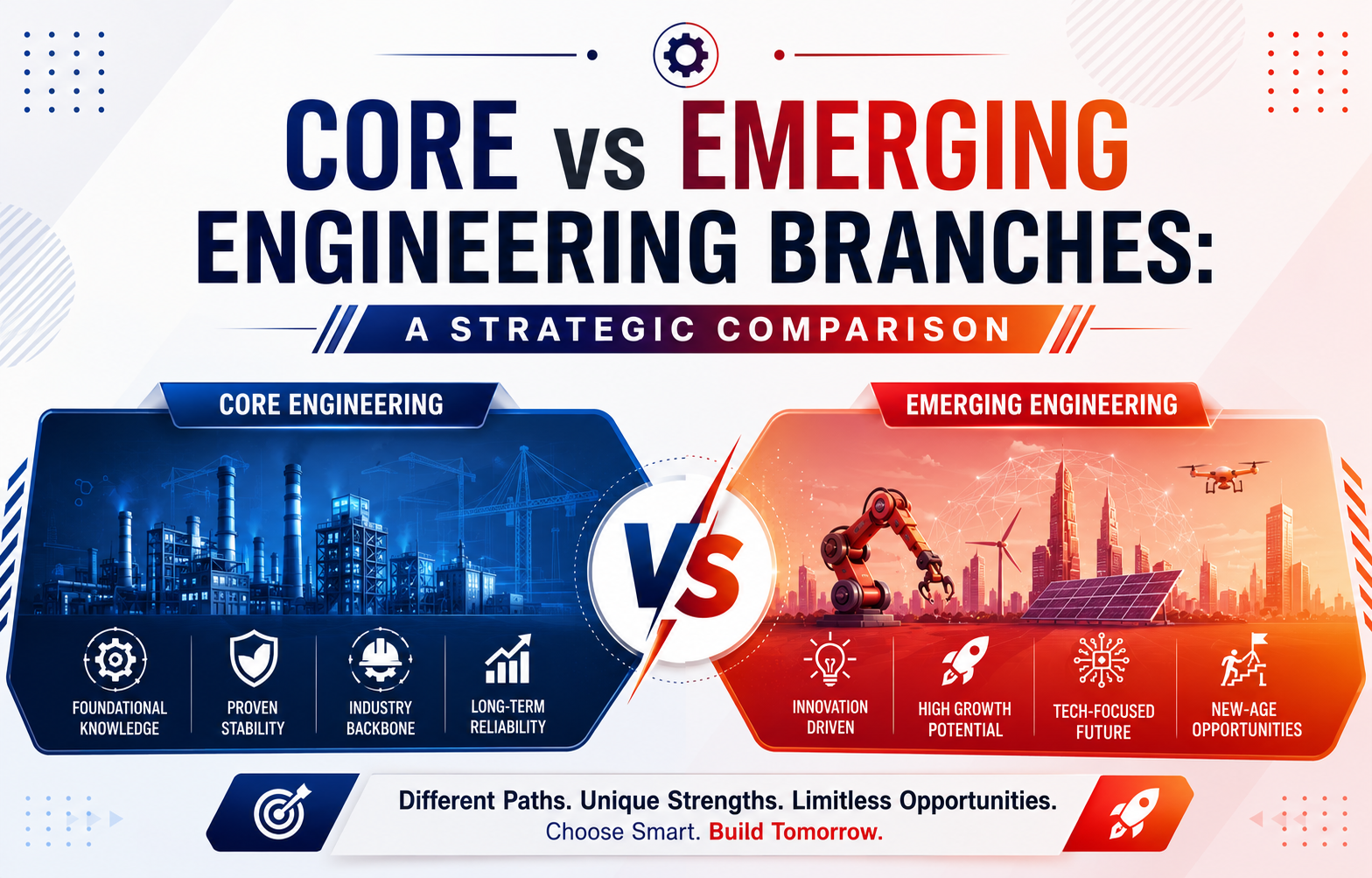
Core vs Emerging Engineering Branches: A Strategic Comparison
What core branches still get right
Mechanical, Civil, Electrical, and Electronics & Communication earned their reputation the hard way — by staying relevant through multiple waves of technological change. A civil engineer's job hasn't fundamentally changed just because software got smarter; buildings still need to stand up, and someone still needs to understand load-bearing walls and soil composition. Same with electrical grids, HVAC systems, or automotive drivetrains. These are physical problems, and physical problems don't disappear because there's a new app for something.
There's also a practical argument for core branches that often gets ignored in these conversations: government recruitment. PSUs, railways, defence research, and infrastructure projects still hire heavily from core streams, and those jobs come with a kind of stability that private-sector tech roles rarely offer. The catch is that salary growth in core roles tends to be gradual rather than explosive, at least early on. You're not likely to see a fresh Mechanical graduate doubling their salary in two years the way some AI hires do — but you're also less likely to face the kind of volatility that hits tech-heavy job markets during a slowdown.
Why AI & ML programs took off so fast
Here's the thing nobody predicted five years ago: a standalone B. Tech in AI & ML would become one of the most searched-for engineering programs in the country. It happened because companies ran out of people who could actually build and deploy machine learning models, not just talk about them in interviews. Healthcare startups want people who can build diagnostic models. Banks want fraud-detection systems. Even agriculture and logistics companies are hiring AI engineers now, which would have sounded absurd a decade ago.
A proper B. Tech AI program isn't just Computer Science with a new label slapped on it — at least not when it's done well. It goes deep into neural networks, computer vision, NLP, and reinforcement learning, backed by heavier doses of statistics and linear algebra than a traditional CS syllabus usually carries. Students graduate genuinely equipped to work on model training and deployment from day one, which is a big reason placement packages in this space have climbed so quickly.
But there's a real risk hiding in that excitement. AI as a field moves fast enough that a tool taught in first year can feel dated by final year. And because it's still a young discipline, the quality gap between colleges is enormous — one institution's "AI & ML department" might mean state-of-the-art GPU labs and faculty publishing real research, while another's might mean a rebranded CS department with two new elective subjects. Anyone choosing this path needs to look past the brochure and actually check what's being taught, by whom, and with what infrastructure.
The middle path nobody talks about enough
This is where things get genuinely interesting, and where I think most career advice falls short. Between "safe old-school branch" and "trendy new AI degree," there's a third option that quietly makes a lot of sense: Computer Science Engineering with AI & ML certification, or its close cousin, Computer Engineering with AI & ML certification.
The logic here is simple. You still get the full Computer Science or Computer Engineering degree — operating systems, data structures, databases, networking, software engineering — the stuff that keeps you employable across the entire tech industry, not just the AI slice of it. On top of that foundation, the certification layer adds focused, verifiable training in machine learning frameworks, model building, and AI tools, usually delivered through industry-aligned modules or partnerships with companies actively hiring for these skills.
What this buys you is optionality. If the AI hiring boom cools off in a few years — and cycles like this do cool off — a CS or Computer Engineering degree still opens doors into web development, cloud computing, systems design, or cybersecurity. But if AI keeps growing the way it has, the certification means you're not starting from zero when a recruiter asks what you've actually built. A few colleges have started structuring these certifications around real capstone projects rather than just extra lecture hours, which honestly makes a bigger difference than the certificate itself.